Midnight Sun Horse Riding In Iceland: Evening Rides In Summer
Riding an Icelandic horse at 10pm under a sky that never darkens is one of the quiet advantages of a June or July trip, and several stables run departures built exactly for it.
Short answer
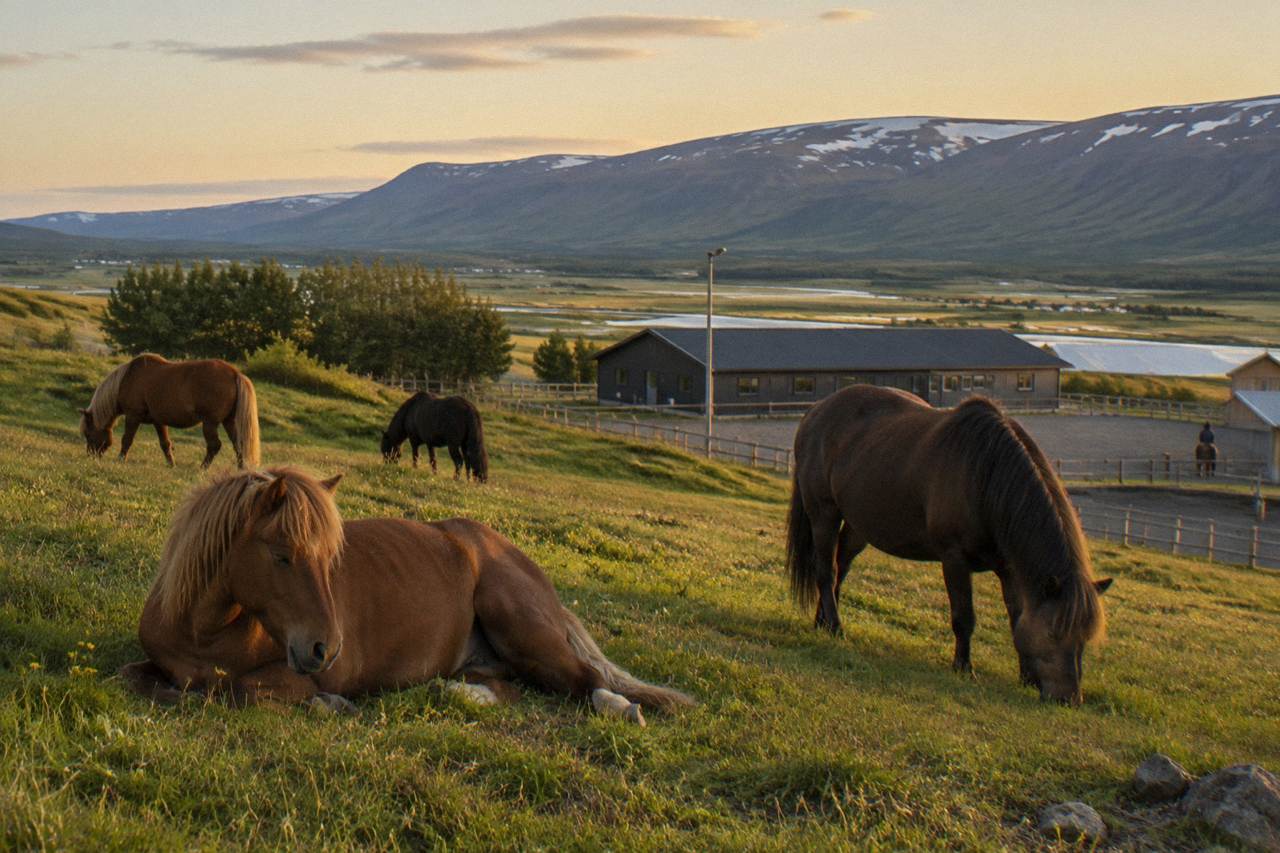
Midnight sun horse riding in Iceland means an evening or late-night summer ride under near-continuous daylight. Reykjavik gets about 21 hours of daylight in mid-June, and Viking Horses runs evening departures from 19:00 to 22:00. Most summer evening rides cost from $129 to $234 per person.
What Is Midnight Sun Horse Riding In Iceland?
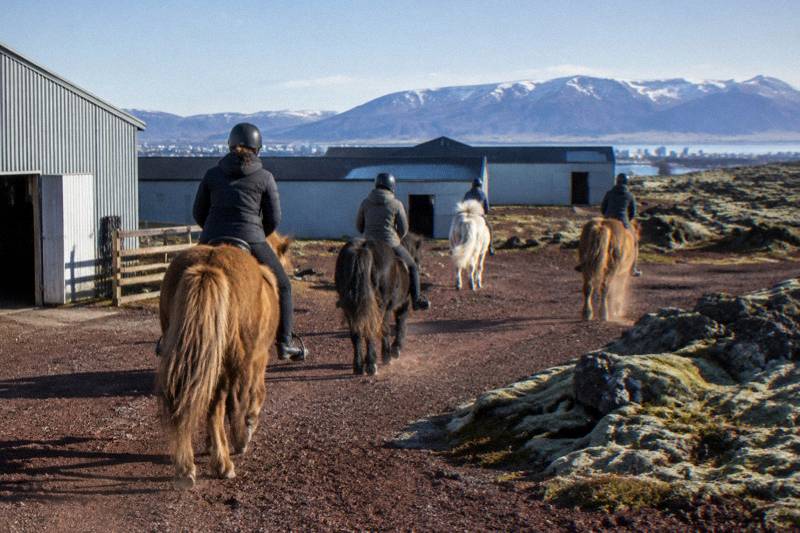
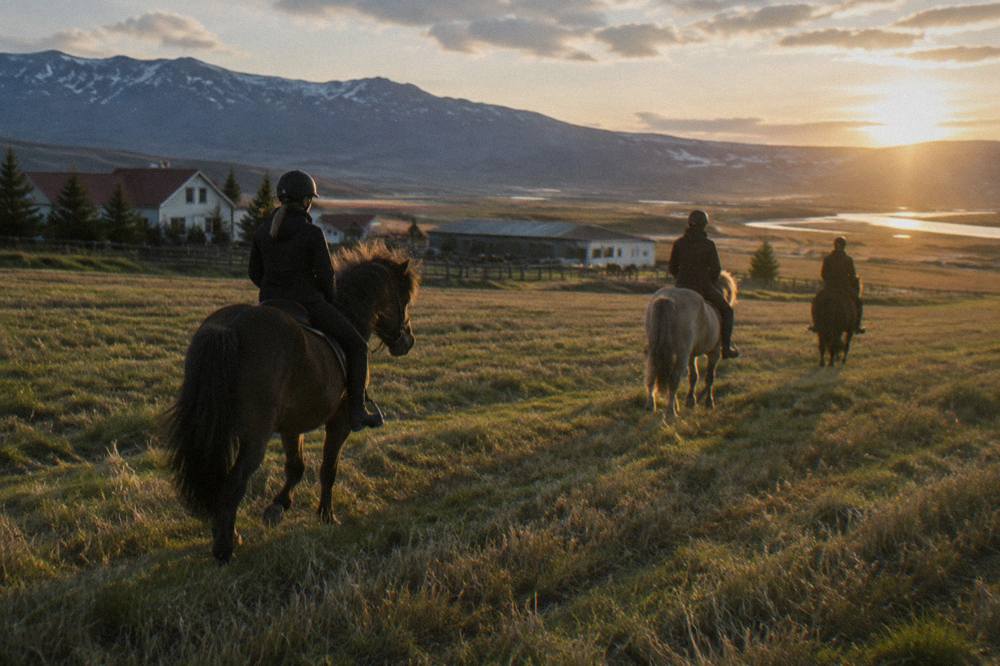
Midnight sun horse riding is a summer evening ride taken during the weeks when Iceland's sky never goes fully dark, roughly mid-May to mid-July, when Reykjavik still receives around 20 to 21 hours of daylight in June. Instead of a 10am departure in tour-bus traffic, you ride at 19:00 or 20:00 through low golden light, empty trails and a landscape that stays bright past 11pm. A handful of operators schedule departures specifically for this window, and the experience is very different from a midday ride: fewer groups on the paths, softer light for photographs, and horses that are often calmer in the cooler evening air.
The phenomenon itself is simple geography. Iceland sits far enough north that around the June solstice the sun dips only briefly toward the horizon and the sky stays in extended twilight all night. Visit Iceland describes the midnight sun period as running from mid-May to mid-July, with Reykjavik receiving around 20 to 21 hours of daylight each day in June, and towns farther north such as Akureyri experiencing nearly 23.5 daylight hours. For a rider, that translates into a practical fact: in mid-June you could book a 20:00 departure and still finish the ride in full daylight.
Not every stable leans into it. Most riding tourism in Iceland still runs on a morning-to-afternoon rhythm built around bus schedules and day-tour logistics. But the operators that do ride late, and there are several good ones, offer something the morning slots cannot: the trail at the hour when most photographers would choose to be out. This guide covers when the light actually works, which stables ride evening hours, what the summer rides cost, what to wear at 20:00 in June, and how the experience differs for beginners and families.
One framing note before the details. The phrase "midnight sun ride" is a marketing shorthand; on most evening departures you ride in bright evening light rather than at literal midnight, and no operator can promise clear skies or a specific quality of light. What you are booking is a late departure in a season when darkness barely arrives. The Icelandic Meteorological Office publishes real-time forecasts, so a quick check of the cloud cover forecast the day you book is a sensible habit rather than an act of faith.
How Many Daylight Hours Do You Actually Get For A Summer Ride?
In Reykjavik, the 15th of June gives about 21 hours and 2 minutes of daylight; Akureyri, farther north, gives about 23 hours and 3 minutes. By mid-July Reykjavik is down to roughly 19 hours 43 minutes, and by mid-August about 16 hours 24 minutes. The practical midnight sun riding window is June and the first half of July, when a 20:00 departure still finishes in full light. The numbers come from sun tables for 2026, and they matter because they define which calendar dates make an evening ride genuinely different from an afternoon one.
The table below shows the pattern across the summer half of the year. Notice how quickly the margin narrows once you move past July: Iceland loses daylight fast in August, roughly four to five minutes per day in the capital area.
| Date (15th of month) | Reykjavik daylight | Akureyri daylight | Evening ride at 20:00 |
|---|---|---|---|
| April | 15h 05m | 15h 19m | Bright, but sunset follows soon after |
| May | 18h 24m | 19h 02m | Full daylight, sunset well after 22:00 |
| June | 21h 02m | 23h 03m | Full daylight; sky never fully darkens |
| July | 19h 43m | 20h 41m | Full daylight, golden light late |
| August | 16h 24m | 16h 46m | Light fading by 21:30 to 22:00 |
| September | 13h 02m | 13h 07m | Evening rides effectively over |
Temperature and rain track the same curve, and they matter for comfort on a late ride. June is both the warmest-adjacent and one of the driest months in the capital area: Reykjavik normals show a June average high of 13.0°C with 43.3 mm of rain, against 87.0 mm in September. Akureyri is drier still in June, at 20.7 mm. The catch is that "warm" in Iceland means a high in the low teens, and an evening ride at 20:00 will feel several degrees cooler than the afternoon peak, so the packing advice later in this guide is not optional even in June.
The other seasonal factor is wind and how it shapes light. Still June evenings are when the low-angle sun does its best work across lava fields and black sand, and a calm evening in the north or the south coast can produce light that lasts visually for an hour after the sun has technically set. Riders who want photographs out of the ride should aim for the first three weeks of June, when the window is widest and the light latest, and accept that any specific evening's conditions are a forecast question, not a booking guarantee.
Which Stables Offer Evening And Late-Night Rides?
Viking Horses is the clearest fit: its daily volcano, Mjölnir and evening departures include a 19:00 to 22:00 slot during the 1 May to 30 September season, making it the most explicit evening-ride product near Reykjavik. Most other stables run afternoon-final departures, so a "midnight sun ride" outside the capital usually means booking a late afternoon slot in the north or east where daylight runs even longer. The honest picture is that few operators label a tour "midnight sun ride"; you are matching late departures to the light calendar from the previous section.
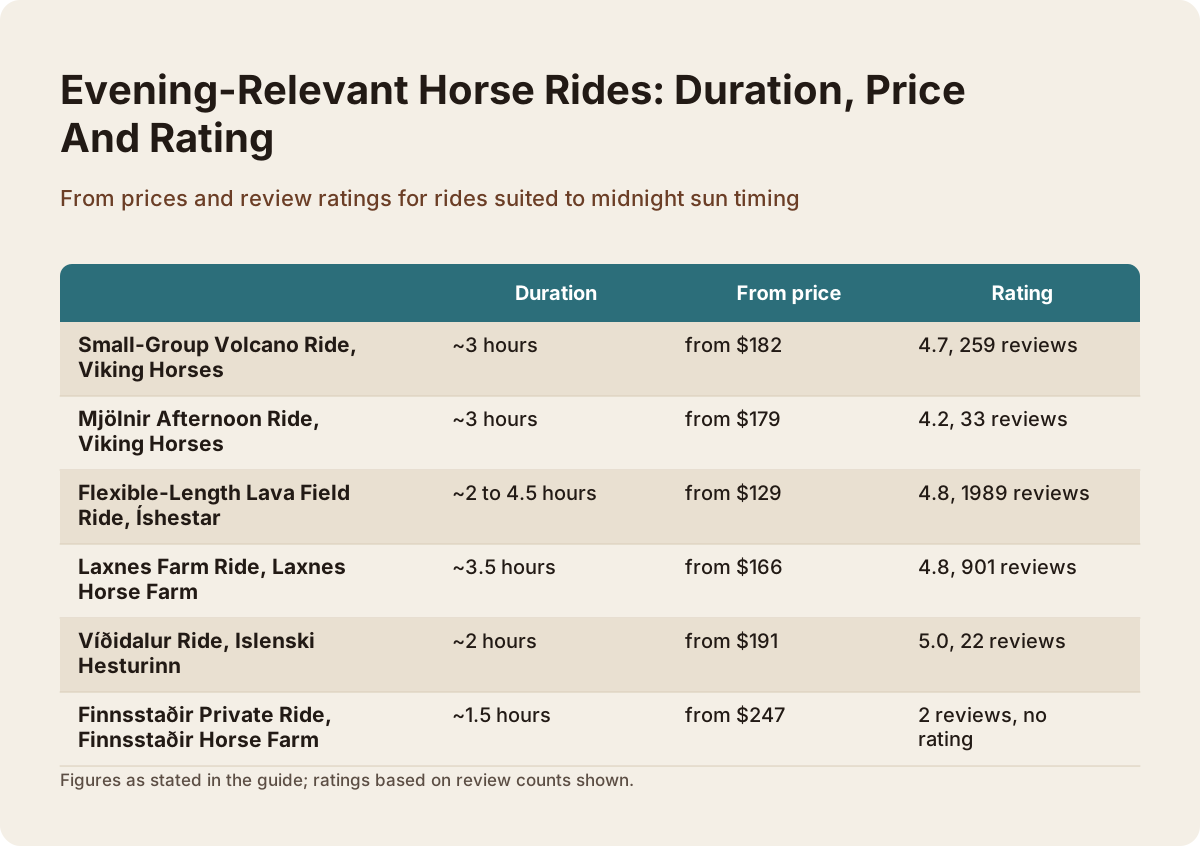
The Viking Horses volcano ride is the strongest single choice for the evening window: it is a small-group tour, capped at 8 riders, rated 4.7 across 259 reviews, about 3 hours door to door with 1 to 1.5 hours in the saddle, from $182 per person, with free pickup within Reykjavik city center and a 110 kg rider weight limit. The operator describes the volcano tour as beginner friendly and all levels, which matters if your evening ride is also your first ride. The Mjölnir afternoon ride from the same stable, from $179, is the same family of experience on a different route; the roster lists it at 4.2 across 33 reviews.
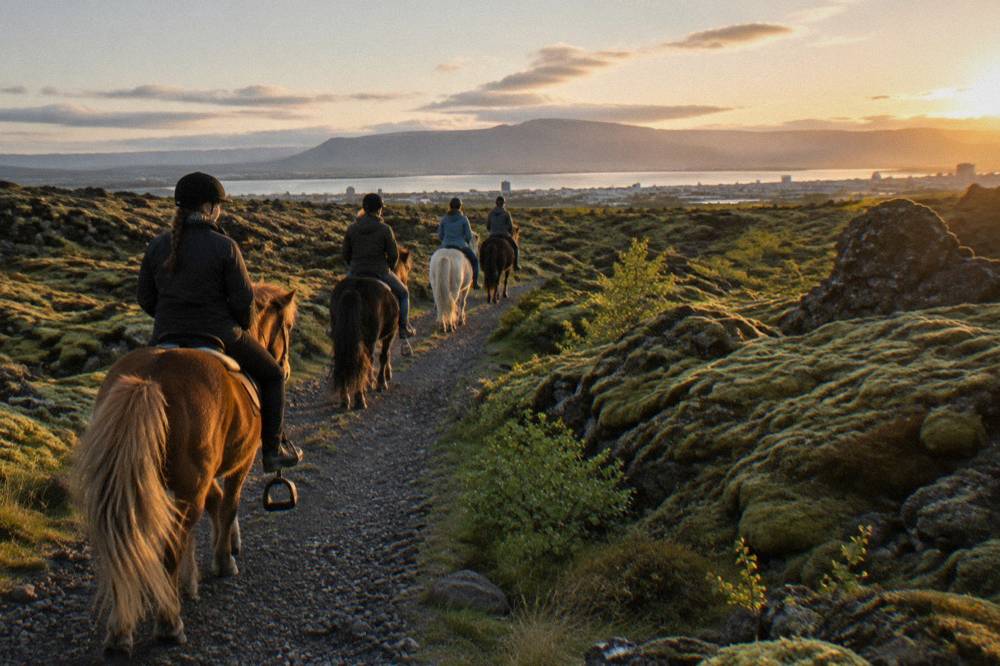
Beyond Viking Horses, the practical move is to look at the latest departure each stable offers and compare it against sunset. The table below pulls the roster's evening-relevant options.
| Ride | Operator | Duration | Price | Rating | Evening fit |
|---|---|---|---|---|---|
| Small-Group Volcano Ride | Viking Horses | ~3 hours | from $182 | 4.7, 259 reviews | 19:00 departure in season |
| Mjölnir Afternoon Ride | Viking Horses | ~3 hours | from $179 | 4.2, 33 reviews | Latest afternoon slot |
| Flexible-Length Lava Field Ride | Íshestar | ~2 to 4.5 hours | from $129 | 4.8, 1989 reviews | Afternoon departures, pickup offered |
| Laxnes Farm Ride | Laxnes Horse Farm | ~3.5 hours | from $166 | 4.8, 901 reviews | Hotel pickup, afternoon timing |
| Víðidalur Ride | Islenski Hesturinn | ~2 hours | from $191 | 5.0, 22 reviews | Late light over volcanic landscape |
| Finnsstaðir Private Ride | Finnsstaðir Horse Farm | ~1.5 hours | from $247 | 2 reviews, too few for a rating claim | Far-north light, private timing |
Two of these deserve a note on region. The Víðidalur ride from Islenski Hesturinn, The Icelandic Horse, is a 2-hour volcanic landscape ride at 5.0 across 22 reviews, from $191, with no pickup, so it suits a traveler with a car who can time the departure to the light. The Finnsstaðir private ride in Egilsstaðir, from $247 for 1.5 hours, sits in the east fjords region where June evenings stay bright as long as anywhere on the island; the listing has only 2 reviews, too few to support a rating claim, but a private tour means you set the hour with the farm. The operator's own page describes a private format that includes practice in a fenced area, a scenic ride, equipment, refreshments and farm access.
For the full picture of how these fit against every other option, the compared Icelandic riding tours guide breaks the whole roster down by region, price and rider level, and the how to choose horseback riding in Iceland guide walks the decision if you are still weighing morning against evening.
How Long Are Midnight Sun Rides And What Do They Cost?
Summer evening rides run from about 1 to 3 hours in the saddle, with door-to-door tour times of 1.5 to 3.5 hours once pickup and gear are counted. Prices across the evening-relevant roster run from $129 per person for the Íshestar lava field ride to $247 for the Finnsstaðir private ride in the east, with most Reykjavik-area options between $166 and $234. Every figure here is a "from" price; the live listing shows the current number for your date, and summer evening slots are priced like any other summer departure rather than at a midnight-sun premium.
The cost logic is worth understanding before you book. Icelandic riding tours price mainly on saddle time and inclusions, not on the hour of the day. A 3-hour small-group ride with pickup, such as the Viking Horses volcano ride at from $182, costs about the same at 19:00 as its morning equivalent would at 10:00, because the operator's costs, guide, horse, transport, gear, are identical. What changes is availability: evening slots are fewer in absolute number, since most stables run one or two late departures against four or five morning ones, and they sell out earlier in peak June and July weeks.
| Ride | Saddle time | Total tour time | From price | Pickup |
|---|---|---|---|---|
| Íshestar Comfort Ride | ~50 minutes | ~50 minutes | $128 | No |
| Íshestar Lava Field Ride | ~2 hours | ~2 to 4.5 hours | $129 | Yes |
| Eldhestar Siggi Ride | ~2 hours | ~2 hours | $135 | Yes |
| Laxnes Farm Ride | ~2 hours riding | ~3.5 hours | $166 | Yes |
| Viking Horses Volcano Ride | 1 to 1.5 hours | ~3 hours | $182 | Yes |
| Íshestar Viking Express Ride | ~2.5 hours | ~3 hours | $234 | Yes |
A useful budgeting anchor: across the whole 30-listing roster, day rides run from $86 for a 30-minute waterfall photo ride in the north up to $307 for a full riding-and-snorkelling combo, so an evening summer ride sits comfortably in the middle of the market. The detailed price breakdown, including what drives the differences, is in the horseback riding cost in Iceland guide, which compares the same roster by price band.
Cancellation terms matter more for evening rides than morning ones, because summer weather in Iceland can swing within a single afternoon and an evening forecast only becomes clear late in the day. Viking Horses publishes a full refund more than 14 days before departure, a 20% fee at 7 to 14 days, 50% at 4 to 7 days and no refund inside 4 days, with all cancellations in writing by email. Sólhestar offers a full refund for cancellations 24 hours or more before departure and is non-refundable inside 24 hours, with a five-day threshold on scheduled group rides. Read the specific operator's terms on the live listing before assuming flexibility; the ranges above are operator-stated, not a general rule.
What Should You Wear On A Summer Evening Ride?
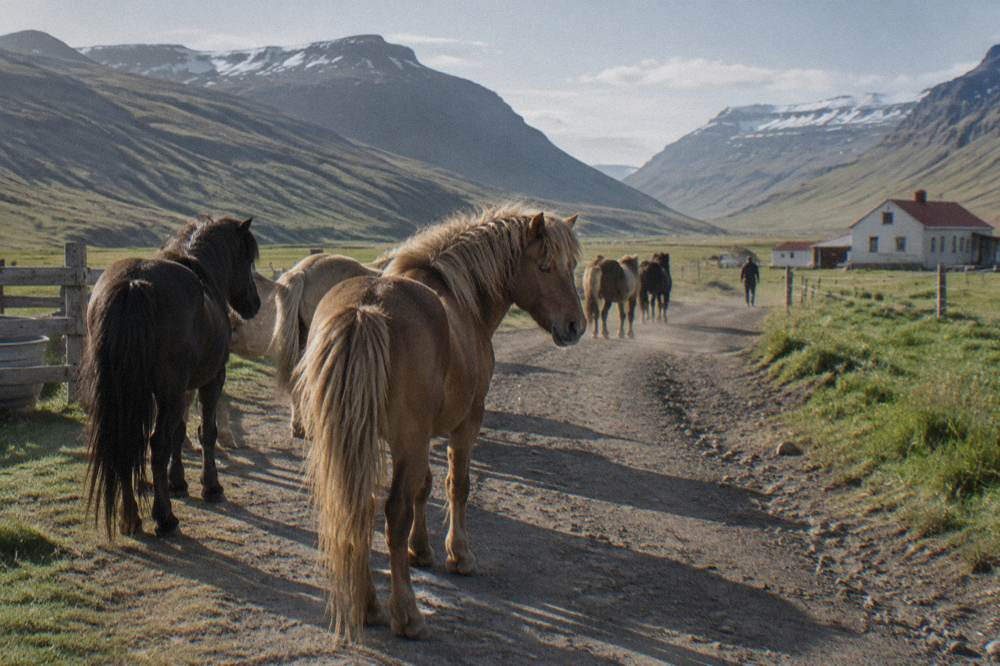
Dress for a June evening high of roughly 10 to 13°C that feels colder with wind, in layers you can shed: a thermal base layer, a fleece or midlayer, a wind-and-waterproof outer, and long trousers. Nearly every stable supplies helmets, rain gear and rubber boots, so you do not need riding-specific footwear, but you do need to arrive in clothes that can take Icelandic weather at 20:00. The evening temperature drop is the one thing that catches out riders who dressed for the afternoon.
The operator-supplied gear covers almost everything you would otherwise rent. Íshestar lends a helmet, warm overall or rain coat and rain pants, plus rubber boots. Laxnes supplies boots, helmets and rain gear or overall snowsuits. Viking Horses provides high-quality saddles, helmets, gloves and rain clothes. Eldhestar supplies helmets, rain gear and warm overalls. In practice you bring the layers next to your skin and the stable covers the rest, which is why the what to wear horseback riding in Iceland guide recommends planning around base layers rather than around specialized riding kit.
One rule is stricter than any packing tip, and it applies to riders bringing their own gear from abroad. The Icelandic Food and Veterinary Authority prohibits import of used riding equipment outright: saddles, bridles, nosebands, pads, rugs and whips, and used riding gloves, are all banned. Used riding clothes and boots must be machine washed or dry cleaned before entry, and items that cannot be washed must be rinsed with detergent, dried, sprayed with 2% VirkonS and stored at least 5 days before contact with horses. Since the stable supplies everything anyway, the simple answer is to bring nothing used and leather, and ride in the operator's gear. The full index of guides sits on Iceland Horse Tours.
For the evening slot specifically, two small additions earn their place. Sunglasses help with low sun directly on the trail, and a thin pair of gloves, new, not used, keeps hands warm on the reins once the sun drops toward the horizon. Mosquitoes are not an Icelandic problem, so repellent is unnecessary weight. If your ride includes a photo stop, which several northern tours do, a phone or camera in a zipped pocket beats a backpack you have to manage from the saddle.
Is A Midnight Sun Ride Suitable For Beginners And Families?
Yes, with the right tour. Several evening-relevant rides are explicitly beginner friendly: the Viking Horses volcano tour is described by the operator as all levels, beginner friendly, and Íshestar's lava field ride takes beginners and intermediate riders. Age minimums across the main summer operators run from 6 to 12 depending on tour length, so families should check the specific listing rather than assume a shared rule. The evening hour itself changes nothing about difficulty; the tour's pace and group size do.
The age pattern follows tour length more than operator. Viking Horses sets 10 years for beginners and 8 for experienced young riders on its tours. Laxnes allows 7 on its main tour, with exceptions for children who already ride. Íshestar sets 7 on the lava tour and 12 on the longer Viking tour. Sólhestar uses 6 on one-hour tours, 10 on 1.5-hour tours and 14 on rides of 3 hours and longer. Vík Horse Adventure in the south uses 10 on its one-hour beach ride and 6 on a 30-minute family ride. The full breakdown, including the borderline cases, is in the horse riding in Iceland with kids guide.
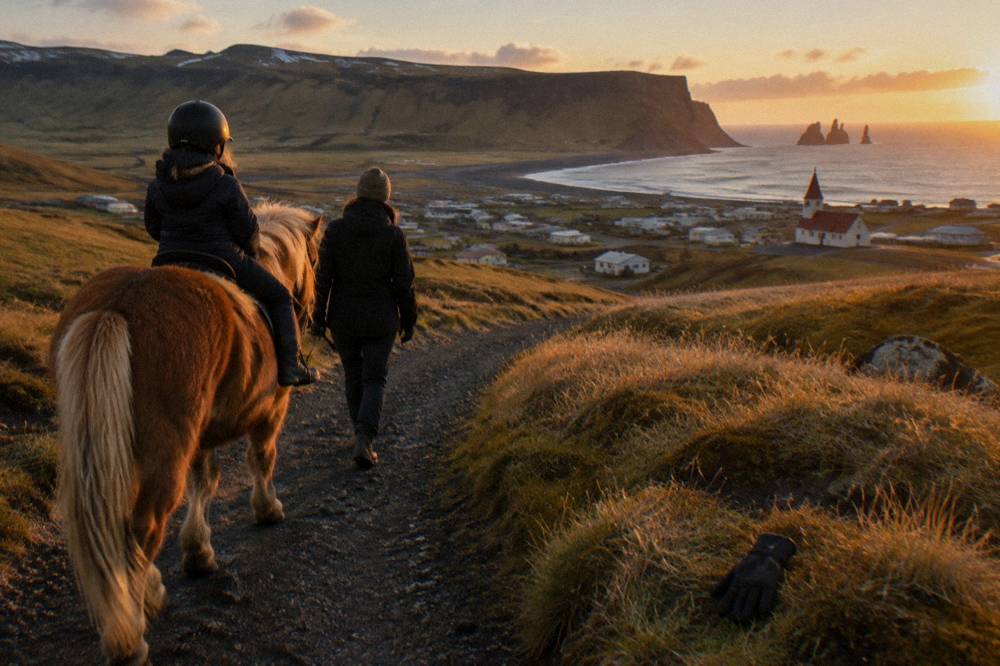
For adult beginners, the honest question is usually fitness and confidence rather than age, and the horseback riding in Iceland for beginners guide covers it in depth. The short version for evening rides: a late departure can actually suit a nervous first-timer, because trails are quieter, horses have worked the day and settled, and the pace on beginner-designated tours stays at walk with some tölt for riders who are comfortable. The Icelandic horse's tölt, the smooth four-beat lateral gait the breed is known for, is the reason so many first rides in Iceland go well; there is no jarring trot phase on the trails most beginners ride, as the breed resource at Horses of Iceland explains in its gait guide.
Group size is the other lever. The Viking Horses volcano ride caps at 8 riders, which for a family or a nervous beginner is a meaningful difference from a 15-rider string. At the other end of the scale, the private options, the Icelandic Riding private tours near Reykjavik from $154, or the Finnsstaðir private ride in the east, let you set the pace entirely, and a private evening ride is the most flexible format for mixed-ability families where one rider is confident and another is not.
Where Are The Best Regions For Midnight Sun Riding?
The farther north you ride, the longer the light lasts: Akureyri gets about 23 hours of daylight in mid-June against Reykjavik's 21, so the north and east fjords extend the evening window latest. That said, the Reykjavik area holds the deepest supply of late departures and the only explicit 19:00 to 22:00 evening slot, so most midnight sun rides happen within an hour of the capital. Region choice is really a choice between convenience and extremity of light.
In the north, the Hestasport Viking ride at Varmahlíð in Skagafjörður, from $118, rated 4.9 across 223 reviews, about 1.5 hours, is the standout value, and Hestasport operates short tours from 1 hour year-round. Around Akureyri, the Deacon ride from Stable Stop runs about 2 hours 15 minutes at 4.9 across 51 reviews from $153, and AK Hestaferdir offers rides with photo stops from $123. The north Iceland Skagafjörður guide and the Akureyri riding guide cover the region in full, including the fact that Skagafjörður is the heartland of Icelandic horse culture.
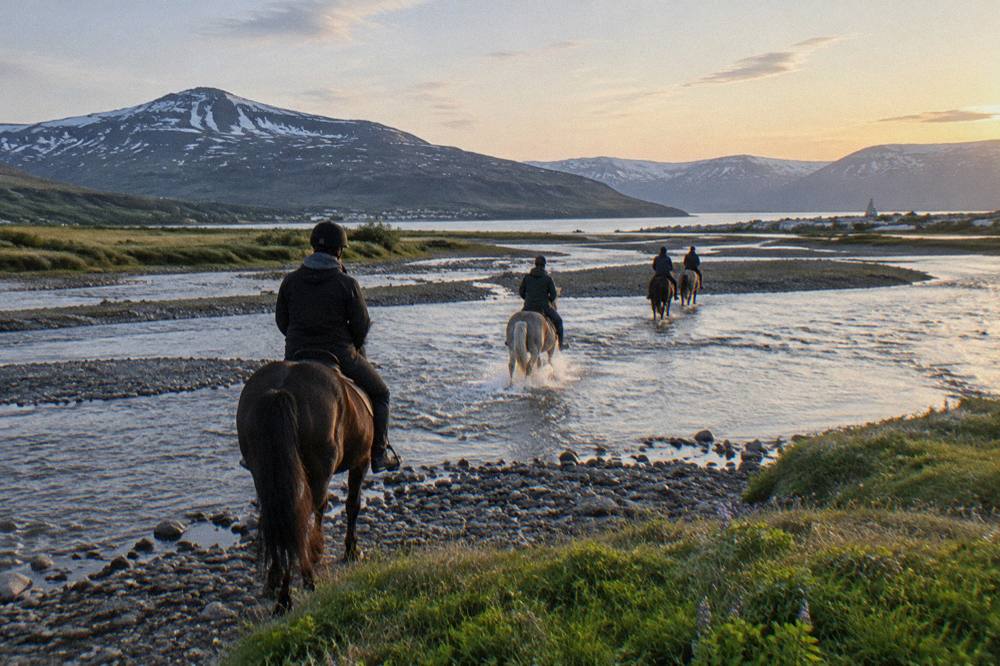
In the south, the black sand rides near Vík make a strong evening pairing because the coast light is dramatic when the sun sits low. The 1-hour Vik Horse Adventure black sand ride, from $126, rated 4.8 across 571 reviews, is the most reviewed beach option in the roster, and the operator notes most people arrive by rental car, since the stable is around a 3-hour drive from Reykjavik. The black sand beach riding near Vík guide covers the beach options, and the south coast riding guide places them in the national picture.
A practical route plan for a light-chaser looks like this: base yourself in Reykjavik for the first leg and take an evening volcano or lava field ride in the first week of June, then drive the ring road east or north, where the same calendar date buys you an extra hour or two of usable evening light. If your dates are fixed to late July, flip the priority: the light is gentler everywhere by then, and the north's extra hour matters less than picking the landscape you actually want to ride through.
How Do You Book An Evening Slot Without Getting Burned?
Book the tour first and the evening light second: pick your dates, choose a late-departure ride from the roster, then confirm the actual departure time on the live listing before you commit, because "evening" varies between a 17:00 last departure and a true 19:00 start. Check the operator's cancellation window at the same time, since Viking Horses needs 14 days for a full refund and Sólhestar needs 24 hours. The two mistakes are booking a morning slot by accident, and booking a non-refundable slot before your travel dates are firm.
The booking mechanics are simple on every listing in the roster. You pick a date and a departure option, where offered, and the listing shows the live price and the remaining seats. Pickup options are worth selecting at booking rather than later: Viking Horses includes free pickup within the city center, Íshestar picks up from major points at set times such as 08:45 and 12:45 on the lava tour, and Laxnes notes its timetable only allows pickup in Reykjavik center or nearby hotels, so a guesthouse ten minutes out may need to meet at a central stop. The stables and pickup guide maps which stable picks up where, and the getting to stables without a car guide covers the car-free case.
Timing within the season deserves one last thought. The first three weeks of June give the latest light and the fullest midnight sun effect, but they also give the fullest calendars, since schools in much of Europe and North America are still in session and the serious summer crowds have not yet arrived. Early July keeps most of the light with noticeably more riders on every trail. Mid-July onward the effect fades quickly, and by mid-August an evening ride is a pleasant late-afternoon ride rather than a midnight sun experience. If the light is the point of your trip, June wins; if flexibility on price and availability is the point, aim at the first week of July and take the 19:00 departure anyway.
Common Questions About Midnight Sun Riding
Midnight sun horse riding in Iceland: when is the best time?
Mid-June, roughly the 1st to the 21st, gives the latest light: about 21 hours of daylight in Reykjavik and 23 in Akureyri. The first week of July keeps nearly the same light with better availability. By mid-August the effect is gone.
Can you ride a horse at midnight in Iceland?
Not on a scheduled public tour. The latest listed departure near Reykjavik is Viking Horses' 19:00 to 22:00 slot, which finishes in full daylight rather than at midnight. A private tour, booked directly with a farm, is the only way to set a later hour, and even then most operators keep horses on a normal working schedule.
Is it cold riding in the Iceland summer evening?
Cooler than the afternoon, yes. June evening highs around Reykjavik sit near 10 to 13°C and drop after the sun lowers, and wind takes more off that. Layers plus the operator-supplied rain gear and overalls cover it; every major stable lends helmets, boots and outerwear.
How much does an evening horse ride in Iceland cost?
The same as an equivalent daytime ride: evening-relevant roster prices run from $129 per person for the Íshestar lava field ride to $247 for the Finnsstaðir private ride in the east, with most Reykjavik-area options between $166 and $234. The live listing shows the current price for your date.
Do you see the midnight sun and northern lights on the same trip?
Not in the same weeks. The northern lights season runs September to April, and the midnight sun window is mid-May to mid-July; the two barely overlap at the fringes. A June visitor rides under midnight sun; a late-September or March visitor rides under darkness with a chance of aurora, which no operator can promise.
Which stables near Reykjavik ride in the evening?
Viking Horses is the explicit one, with a 19:00 to 22:00 departure in season on its volcano and related tours. Íshestar, Laxnes and Islenski Hesturinn all run afternoon-final departures that still finish in bright June evening light; check the exact departure time on the listing before booking.